
A Changing Fundraising Landscape
In today’s arts and culture sector, fundraising is no longer just about cultivating generosity, it’s about cultivating understanding and impact. As organizations face growing complexity, shifting donor behaviours, and a need for transparency and the diversification of revenue streams, one thing has become clear: data and fundraising are inseparable.
We often think of data as something clinical, numbers in spreadsheets or CRM dashboards. But data, when connected to purpose, becomes a storytelling tool. It helps us see patterns, test assumptions, and most importantly, make decisions rooted in evidence rather than instinct.
According to the DNA Platform’s 2023 data, of the 4,472 charitable arts organizations, fundraising revenues represent, on average, 10% of their total revenues. While organizations are still relying heavily on public grants to support continued operations, diversifying revenue through fundraising could help organizations expand the total amount of support they are able to access.
Why should we grow the fundraising piece of the pie? Because a balanced, robust and diversified financial strategy that includes fundraising strengthens the organization’s ability to weather challenges, grow its impact, and focus on achieving its mission efficiently and effectively
This is where Mass Culture’s Evaluating Your Fundraising Readiness Rubric will come in handy. This framework is a tool designed to help organizations move from intuition to insight by assessing their readiness, identifying capacity gaps, and building data-driven strategies for fundraising growth.
Introducing the Evaluating Your Fundraising Readiness Rubric
Co-created with our partners at Forward Avenue, the Evaluating Your Fundraising Readiness Rubric is more than a checklist. It’s a lens for reflection and alignment. It helps organizations evaluate their fundraising capacity across seven interconnected dimensions:
- Strategic Alignment – clarity of mission, leadership, and collaboration
- Human Resources – staff skills, well-being, and professional development
- Processes & Technology – efficiency, integration, and donor data flow
- Champions – leadership and board engagement in fundraising
- Planning & Evaluation – strategic clarity and evidence-based goal setting
- Case for Support – a compelling narrative that aligns mission and data
- Culture of Philanthropy – shared responsibility and authentic relationship-building
Each component is designed not just to evaluate performance, but to prompt learning and action. For instance, an organization might discover that while their Case for Support is inspiring, their data systems don’t yet capture donor engagement in a consistent way or in a centralized place. Or they may find strong leadership enthusiasm, but inconsistent cross-department collaboration.
When fundraising is treated as something that belongs to one person, one department, or one moment in the year, it rarely sticks. At Forward Avenue, we’ve worked with many small and medium sized charities and have seen that organizations make the biggest leap not by simply putting more hours and dollars into fundraising, but by aligning the pieces that make fundraising possible: vision, strategy, systems, people, and culture. This is why we are excited to collaborate with Mass Culture to design this Fundraising Readiness Rubric. To truly move the needle on your fundraising, you need to know where you are at, where you are aspiring to, and how you are tracking your progress, learnings, and successes along the way.
Betty Xie. Founder & Principal. Forward Avenue
By using this tool as both a readiness survey and a planning guide, organizations can begin to see how each part of the fundraising ecosystem connects across people, process, purpose and data.
Why Data Matters in Fundraising: Insights from “Data and Fundraising”
Data is not an end in itself but rather a bridge between reflection and decision-making. Many organizations collect data (donor lists, ticket buyers, surveys), but fewer know how to turn that data into meaningful insights.
When used well, data can:
- Reveal which fundraising activities deliver the strongest return on effort
- Identify patterns in donor retention and engagement
- Strengthen the Case for Support with evidence of impact
- Help boards and champions make more strategic decisions
- Build a culture of shared learning and accountability
In the arts, data should serve creativity, not replace it. It’s about connecting emotion with evidence and ensuring that the stories we tell about impact are supported by the data we hold about it.
When data is applied consistently and intentionally, it can transform how organizations approach fundraising. Take, for example, River Clyde Arts, a community arts organization in New Glasgow, Prince Edward Island.
River Clyde Arts recognized that growing its community impact would require diversifying and expanding its revenue streams and doing so in a sustainable way, without adding to staff capacity. Working alongside Mass Culture and Meena Das as their Data Coach the organization began strengthening its data collection practices: tracking participant engagement, gathering feedback through post-event surveys, and using that information to align its strategic direction with the interests and values of potential donors.
When speaking with our fundraising colleagues across the sector, we often hear how much decision-making has traditionally relied on anecdotal knowledge and insights that were gathered through meetings, conversations, and lived experience. While this still matters, today’s fundraisers have access to data and tools that make it possible to build relationships more intentionally. Demographic and engagement data can reveal donor motivations and inform more targeted communications, while donor history helps organizations understand where someone is in their giving journey which guides not just the message, but the timing and size of the ask. Increasingly, predictive analytics can also help anticipate donor needs and concerns, making fundraising more proactive and effective..
By grounding decisions in real data and translating those insights into personalized communications, River Clyde Arts saw its fundraising results increase, receiving one of the largest donations in the organization’s history. This dedicated work stands as a powerful example of how data-informed storytelling can help arts organizations with a small staff grow their reach, deepen relationships, and deliver more meaningful programming than ever before. If this grassroots organization can do it, so can you. To track our joint learning with River Clyde Arts, we created a Ripple Effect Map, which allows you to travel outward from our first collaboration to the present. By capturing these stages in this way, we can monitor the transformation, assess the impact and evaluate the change, helping to inform future decision-making and activities. Check out their Ripple Effect Map here.
Data can also inform fundraising by aligning vision, programs, finances, and organizational capacity, which is especially critical when time and resources are limited. A strong example of this is Forward Avenue’s work with Toronto-based arts nonprofit Oddside Arts. With Forward Avenue’s fundraising strategy and implementation support, Oddside Arts examined their fee-for-service revenue, expenses, and the true return on how staff time and resources were being allocated. This analysis led to a pivotal realization: distributing effort across piecemeal fundraising asks with limited margins was diffusing impact. Instead, the data pointed toward concentrating energy on a single, visionary project that most closely aligned with Oddside’s thought leadership, impact goals, and theory of change. Acting on this insight, Forward Avenue helped Oddside Arts raise over $150,000 for their Archiving Black Futures: Revisioning Public Art. Oddside Arts is now working with one of Mass Culture’s Data Coaches to further strengthen this flagship research project.
Building Data-Informed Capacity: How the Framework Helps
The Evaluating Your Fundraising Readiness Rubric helps organizations embed data-informed decision-making at multiple levels:
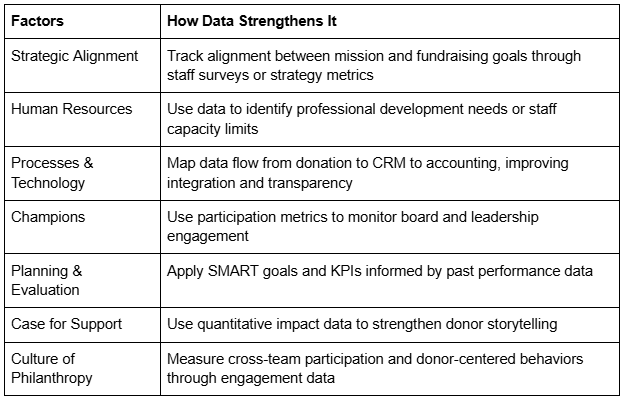
By capturing these indicators, organizations can visualize and benchmark their fundraising health over time. This connection allows for organization-wide learning by identifying patterns.
Making It Real: Data as a Cultural Practice
Shifting to data-informed practices isn’t just technical, it’s cultural. It requires curiosity, openness, and a willingness to learn from both successes and failures.
For organizations with budgets under $100,000, this doesn’t mean sophisticated software; it starts with asking better questions:
- What information do we already have that can help us make smarter decisions?
- How are we tracking the outcomes that matter most to our mission?
- What can we learn from our donors, and how are we listening to them through data?
Data should not intimidate, it should empower. The goal isn’t to turn art workers into analysts, but to help arts workers see their fundraising work more clearly, align it more strategically, and communicate it more convincingly.
For anyone ready to take the next step, the DNA Platform’s Enhanced Dashboards make exploring data both intuitive and empowering. The “Find My Peers” feature allows you to base your fundraising goals on real life data such as revenue, staff size, and primary funding sources, or narrow results by geography from province to municipality to federal riding to gain targeted insights. Its “Benchmarking Made Easy” tools enable organizations to create custom peer groups and compare key data points, such as fundraising activity, proportions of public funding, and revenue or expenses by category. Together, these features help organizations see where they stand, learn from peers, and identify realistic pathways for growth that turn sector data into collective knowledge.
The enhanced Organizational Insights Dashboard data shows that in 2023, of the 1,119 organizations with operating budgets below $450,000, they each raised $73,254 from the private sector and were supported by one full time staff person on average. If you’re an organization of this size, how are you faring in comparison to your peers? How might you enhance your efforts to track better and or improve your results?
A Call to Action
Mass Culture invites arts organizations to use the Evaluating Your Fundraising Readiness Rubric as a starting point for reflection, conversation, and growth. Whether you’re a small collective or a mid-sized organization scaling your fundraising efforts, this tool can help you see where you are, where you could go, and how data can help guide the way.
By combining storytelling and data, reflection and readiness, we can move toward a shared vision of data-informed planning and decision making that supports fundraising success that honours both heart and evidence.
Explore the Evaluating Your Fundraising Readiness Rubric today.