
Did you know that Canada is one of the few countries with a domestic, homegrown company focused on foundational large language models (LLMs) and enterprise AI?
While the AI adoption rate among Canadian businesses remains relatively low compared to other advanced economies, it has doubled compared to the previous year, with 12.2% of businesses reporting they used AI to produce goods or deliver services (Statistics Canada, 2025). So what might this mean for art and culture, and our artists?
In mid-March, Mass Culture joined leaders from across Canada at the National Summit on AI and Culture, co-hosted by the Government of Canada and the Banff Centre, an ambitious gathering designed to explore how AI is shaping the future of cultural creation.
The Summit brought together 300 leaders from the cultural sector, AI research networks, technology industries, and government to address the rapid changes AI is bringing to Canada’s cultural landscape. As part of broader federal efforts, Canada’s first AI Minister, Evan Solomon, announced that there will be a national AI strategy, and that the goal of the Summit was to converge on Canadian AI adoption and economic growth while maintaining safety and ethical standards.
What We Heard
...create AI from a matriarchal and fair perspective to benefit humanity.
Shani Gwin, Founder & CEO of pipikwan pêhtâkwan and wâsikan kisewâtisiwin
Empowering the sector to adapt
Interest in AI adoption is rising across the cultural sector, from production to distribution. At the same time, consistent themes emerged: Ai is a tool. AI should enhance human creativity and not replace it. AI should be built and adopted with trust and transparency.The question here then is, what do we need to adopt?
Pascale Landry (Compétence Culture) shared a study and synthesized ideas about AI adoption that centres on building coordinated, cross-sector collaboration to strengthen AI and digital capacity across the cultural sector while ensuring no one is left behind. It emphasizes developing shared networks, resources, and tailored training that align with evolving workforce needs and the realities of cultural work. At its core, it calls for equitable access to skills development, knowledge, and funding to support a cohesive and inclusive transition toward AI readiness.
What Was Missing
For a summit focused on the future of cultural creation, one absence stood out. While there was strong representation from institutions, policymakers, and technology leaders, working artists themselves were less present in the conversation than they should have been. This matters.
Artists are not only among those most impacted by AI, they are also actively experimenting with it, questioning it, and shaping its possibilities in real time. Their perspectives are essential to ensuring that AI develops in ways that are ethical, equitable, and grounded in creative practice.
Why This Matters Now
Decisions about how AI is being built, governed, and adopted are rapidly happening and changing. Policies are being shaped. Tools are being deployed. Norms are being established.
Without direct input from artists, we risk building systems that fail to reflect the realities of creative work, or worse, undermine it.
Learning to Action: Next steps on the AI Journey
At Mass Culture, we believe this gap is an opportunity and a responsibility.
We are launching a short Curiosity Survey for Artists to better understand how creatives across disciplines are engaging with AI today.
We want to hear directly from you:
- Are you using AI in your work? How and why (or why not)?
- What excites you about these tools? What concerns you?
- Where do you see risks around authorship, compensation, or control?
- What support, resources, or policies would help you navigate this space?
This is not a technical survey. It’s a listening exercise. We’re curious about what you think?
Take the Survey! It takes less than 5 minutes to complete, and your input will help shape how Mass Cultures support the sector in responding to AI. The survey will close on April 27, 2026.
Help Us Reach More Artists
If you know artists, creators, or cultural workers who should be part of this conversation, please share this survey with your networks.
The more perspectives we gather, the stronger and more representative this work will be.
Looking Ahead
The conversations that began at the Summit are only the beginning.
At Mass Culture, we see our role as connecting insights across sectors and ensuring that artist voices are not only included, but central to what comes next. We are already building bridges across arts, culture and creative industries to unite and present a stronger voice.
We will share what we learn from this survey back with the community in the coming months.
Until then, we’re listening.
Mass Culture
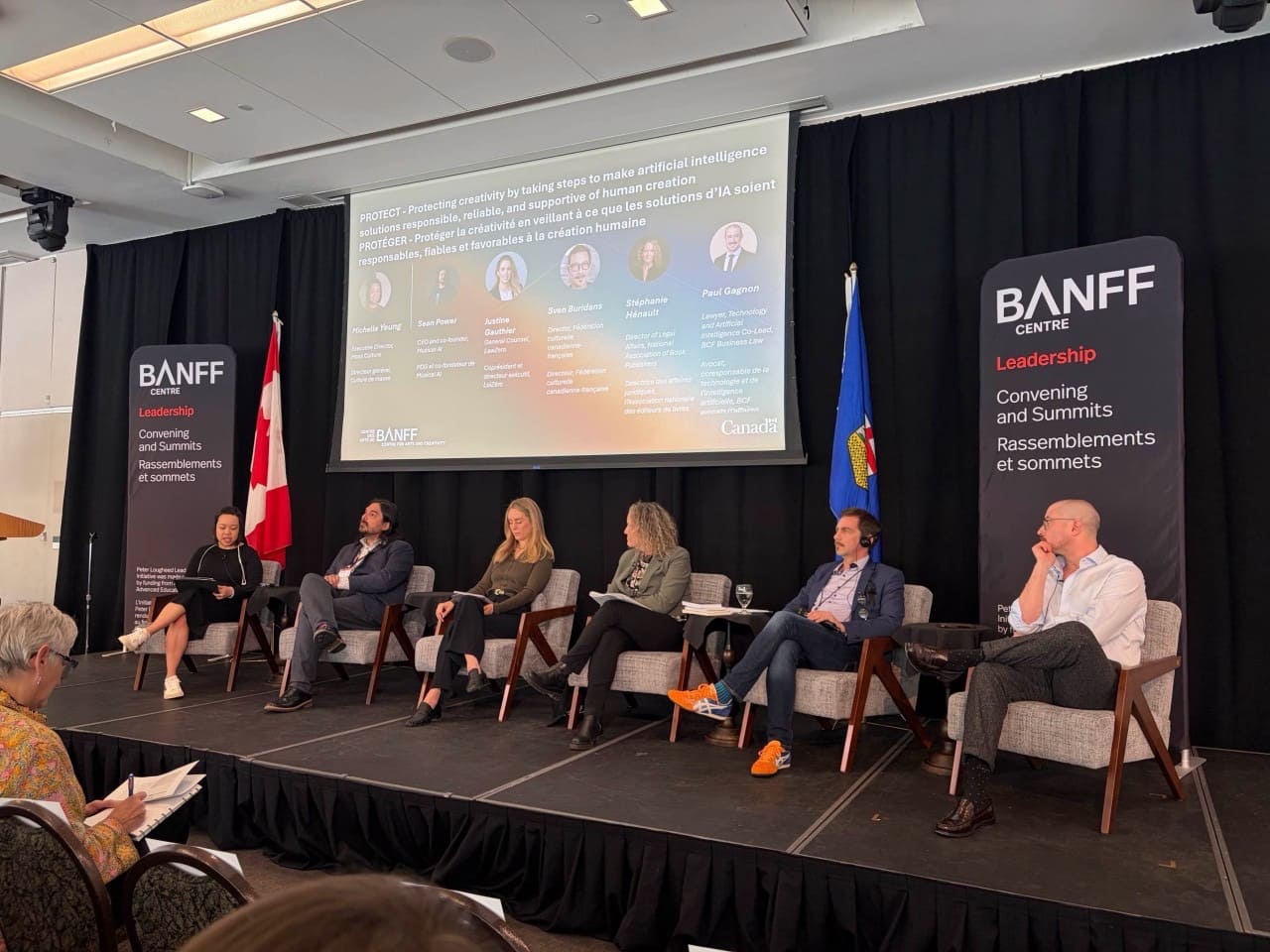
In the Protect Panel Discussion hosted by Mass Culture’s Managing Director, what arose was the need for trust and transparency in LLM information capture, and proper attribution for creative intellectual property.
Pictured (L-R): Michelle Yeung (Mass Culture), Sean Power (Musical AI), Justine Gauthier (LawZero), Stéphanie Hénault (Association nationale des éditeurs de livres ), Sven Buridans (Fédération culturelle canadienne-française), Paul Taylor (BCF Business law).
If you find AI very creative, it is probably because you are not very creative yourself.
David Cropley, Professor of Engineering Innovation, Adelaide University (Australia)
RESULTS ARE IN - The Curiosity Poll for Artists on AI
The Curiosity Poll for Artists on AI gathered responses from 750 artists representing a broad range of artistic disciplines, geographic regions, and relationships to AI.
After reading through the incredible insights shared by artists across the survey, Mass Culture began noticing important nuances in how different groups of artists were thinking and feeling about AI. We’re sharing these insights with you.