


Explore Mass Culture’s projects on Governance here.
Shared Governance
A Living Model grounded in Equity, Trust & Collective Care with Canada's National Ballet School
Canada’s National Ballet School (NBS), in collaboration with Mass Culture, engaged in exploring and identifying key elements of a shared governance model for artists and cultural organizations to facilitate the sharing of a physical space. As NBS moves through a multi-phase feasibility study for its Campus Optimization Project – focused on an expanded physical facility with significant community impact and increased engagement in and love of dance – Mass Culture developed a framework that is rooted, inspired, and co-created by NBS, and the dance and arts community.
After six months of dialogue, creative research approaches, and even a script table-read to present the model, we learned that building a shared governance model at NBS begins with an invitation: “Look beyond the assumptions of your form.”
Building Together: A Guide Through the Shared Governance Model reveals 21 core elements, including:
- Governance Stewardship
- Decision-Making Process
- Communication Process
- Succession & Nomination Process
- A Meaningful & Equitable Partner in Shared Governance
- Flexibility & Long-Term Viability
As part of this research journey, Mass Culture is excited to share resources we believe are highly transferable at a time when finding better ways of working together is essential. Grounded in value driven governance, this guide, along with its complementary tools and templates, is intended to support not only NBS, but any organization seeking to reimagine governance, whether in creative hubs, large staff environments, mergers, or collaborative projects.
If you have any questions about these tools and resources, you can set up a meeting with us below.
We have created a brief walkthrough of the Shared Governance Model in the form of this Primer, offering insights into the key components of the Model.
Click to view
This is a template of the Measurement, Evaluation, and Learning (MEL) Framework that Mass Culture designed to support the testing, learning, and adaptation of governance practices.
Click to view
These four tools were integral to the research journey — from early co-development to knowledge translation. We are sharing them to offer additional insight into our journey.
Click to view
This project was done in collaboration with
The Futures of Arts Work
Board Governance: Emerging Ideas
In the spirit of Twain’s “I didn’t have time to write you a short letter, so I wrote you a long one…,” the output of the first phase of work was valuable but far too long and unwieldy to corral into productive information. So, in the ever-present day-to-day management of COVID-19 response in the arts sector, we decided to narrow the focus to one of the elements that came up often in the LEAN initiative, in the research, and in the conversations in the sector as of late: Board governance.
This report thus looks at one dimension of the future of people systems by focusing on Boards of Directors and their related governance models in Canadian not-for-profit (NFP) arts organizations. The aim of this report is not to replicate the myriad of resources and tools available in an exhaustive literature review, but rather to capture the conversations of the moment in Canada’s arts sector about Board governance innovation—specifically, SHOULD we innovate our Board structures, what are some examples, and what can/should we do. What we share with you here are some select foundational secondary research pieces for context, some examples of “current” conversations about innovation, and the results of a survey held with the sector this year.
We hope that the information shared in this report provides some useful insights and provocations for people to bring to their work, their organizations, and their Boards towards creating a healthier arts ecosystem. We look forward to continuing the conversation!
Resources from Business / Arts
Following the report’s release, Business / Arts hosted an excellent webinar: Emerging Ideas on Arts Governance.
They have also made the presentation slides from the event available here.
The Future of Arts Work project was an idea brought to Mass Culture in 2019 by Co-Author and Research Lead Jeanne LeSage of LeSage Arts Management. The project was conceived as a way to think about new pathways for the arts sector to look at “HOW” it works. The initial project embodied a larger scope—looking at the future of people systems needed for arts organizations in Canada—and started to look at four key areas: Future Arts Institutions, Future Arts Workers, Future Arts Workplaces, and the Future Arts Sector. There was great interest and support in this first stage of the work, as many practitioners were seeing that HOW they worked in their organizations was not supporting their organization’s mission and/or artistic goals. And perhaps ironically, while they could be incredibly innovative in their programs, they were not innovative in their “People Systems.”
Then in March 2020 the global COVID-19 pandemic descended upon the world, and it would be an understatement to say that this changed everything in our sector and in our lives. While the first months of the pandemic became a sped-up backwards fox trot in crisis management, cash flows, and contingency planning to stay “whole,” this notion of being better at HOW we work became even more important. These early pandemic months prompted Celia Smith, Michèle Maheux, and this project’s Lead Researcher and Co-Author, Jeanne LeSage, to create the Leadership Emergency Arts Network (LEAN), which ran from April to September 2020. The initiative offered mentorship and guidance from volunteer advisers for arts organizations across the country grappling with the pandemic. It also highlighted some long-standing issues within the sector and revealed news ones that came to inform the Future of Arts Work and the survey upon which this report is largely based.
And while many projects that started pre-pandemic necessarily shifted focus in efforts to triage the massive impacts of the pandemic on the sector, only minor adjustments were made to the aim and direction of the Future of Arts Work. What we found was that this research was not so much needing to change direction but rather that we needed to double-down on how the sector’s systems and processes impact the people that work in it, and that we should focus on something that was practical for organizations right now.
However, what did shift in this process was the timing and the focus. With the initial broad overview of the four key areas noted above, a first phase of research resulted in the creation of a larger bibliography/reading list and a dialogue with sector participants at the Mass Culture Study dates in June 2020.

Jeanne LeSage, CHRL, MBA, LeSage Arts Management
Lead Researcher & Co-Author
Jeanne is a highly respected senior arts management professional with national and international experience in festivals and multidisciplinary performing arts. She is a sought-after consultant, educator and conference speaker working across Canada with a unique specialization and expertise in Arts HR and Organizational Development. Jeanne is the author of research reports such as “Reporting and Investigation Mechanisms for Workplace Harassment in the Arts”; and the co-founder of the COVID-19 response initiative LEAN (Leadership Emergency Arts Network).
After a first career as a theatre Stage Manager working across Canada, Jeanne has held executive arts management positions at various organizations nationally and internationally. Notable positions include: ten years at the Toronto International Film Festival in Theatre Operations and building their first Human Resources department, Arts Management Fellowship at the Kennedy Center for Performing Arts, Deputy Interim CEO of Royal Opera House Muscat, Managing Producer of the Abu Dhabi Film Festival, and more.

Dr. Shawn Newman
Report Co-Author
Shawn Newman is a consultant, writer, and cultural producer based in Toronto. Formerly the Executive Director of Public Access and Managing Editor of PUBLIC: Art | Culture | Ideas, Shawn’s research interests are in intersectionality, power dynamics, and identity. Some of his previous work includes accessibility in digital publishing, hegemonic whiteness in cultural production, and Reconciliation in the arts. Following his career as a dancer and choreographer, he obtained a PhD in Cultural Studies from Queen’s University.

Senjuti Sarker
Research Associate
Senjuti Sarker is an arts worker, theatre designer, arts manager, facilitator and a librarian. Her practice stretches from arts programming to librarianship with goals of centering community development and investment. She completed her undergraduate in Theatre and Film Studies from McMaster University and her graduate studies in Library and Information Science (MLIS) where her research focus remained on strategizing greater investments in marginalized and equity-seeking communities with public services. During her masters she also investigated how arts-based public programs and services impact new and emerging communities. Some of her previous involvements include working with The AMY Project, The Toronto Fringe and Hamilton Fringe. She is currently the public programming coordinator at the Art Gallery of Hamilton.
I’m interested in the future of Arts Work and Workers because I am one! The precarity of arts work and labour is even in more need of research and real investigation in the middle of this pandemic. As parts of the industry is getting eradicated, it’s also getting redeveloped. I am interested in finding ways to aid in that redevelopment and finding a holistic picture of culture within arts work.

Melanie Wilmink
Research Associate
Melanie Wilmink holds a PhD in Visual Art & Art History from York University (Toronto), with honours such as the 2014 Elia Scholars Award and a 2015 SSHRC Doctoral Fellowship. She completed her MA in Interdisciplinary Studies (Film and Visual Arts) at the University of Regina, where she was a research assistant on Dr. Christine Ramsay’s SSHRC funded “Atom Egoyan In Media Res” exhibition project, and was awarded a Joseph-Bombardier Canada Graduate Masters Scholarship in 2013. With a dissertation focus on the inter-connectivity between spectatorial experience and exhibition spaces, her ongoing research emerged during her role programming for the Calgary Society of Independent Filmmakers, and her independent curating practice including the Situated Cinema project (Pleasure Dome, 2015), and as Curator in Residence for Sidewalk Labs Toronto. She is the co-editor of the anthology Sculpting Cinema (2018) with Solomon Nagler.

I am interested in the Future of Work in the Arts Sector project because I have worked with cultural organizations throughout my career in many different roles. I know the invisible labour that it takes to create successful cultural activities, and how arts workers are often sustained by the passion for their work but lack administrative support. I want to find better ways to support this often undervalued and overworked labour force, so that they can focus on creating an exciting creative landscape in Canada.

Bridget MacIntosh, Digital Engagement Coordinator
Bridget has held senior cultural policy and programming management positions with the cities of Toronto, Mississauga and Hamilton with portfolios spanning arts, events, public art and cultural planning. Notable accomplishments include the creation of the City of Hamilton’s Events Office where she led the design and delivery of numerous city-wide celebrations and extensive community engagement to develop a support system to facilitate 400+ annual creative placemaking, community and tourism events.
As a passionate arts advocate, Bridget’s has contributed to numerous committees and boards with organizations such as the Canadian Arts Coalition; Project for Public Spaces Placemaking Leadership Council, Festivals and Events Ontario, Toronto Alliance for the Performing Arts and foldA (Festival of Live Digital Arts).

Khiem Hoang
Khiem Hoang is a writer, facilitator, and analyst with a passion for culture and community. He worked at Mass Culture as a Research Analyst Intern.
Neeha Dsouza
Neeha is a Research Analyst graduate from Humber College. She has interned with Mass Culture as Research Analyst and is currently working as a Market Research Interviewer for The Logit Group. Neeha came as an international student from India to pursue her studies in Canada. She has a masters degree in forensic science and enjoys reading Agatha Christie.
Shaping Strong Governance workshop
As part of Mass Culture’s Futures of Arts Work report launched in November 2021, Co-Authors Jeanne LeSage and Shawn Newman asked the question: What Can We Now Do To Design our Governance?
Included in the report is the Governance Pathways Worksheet, offered as a tool to organizations to design their governance, in a process including board, leadership and staff.
On January 17th, Mass Culture hosted a hands-on knowledge-gathering workshop, bringing this preliminary tool to the sector to test it out. We worked collaboratively on adapting it, pulling it apart, adding to it and generally exploring it for participants’ organizations’ governance needs. Participants were assigned to breakout rooms dedicated to one of the 3 subject areas detailed in the worksheet: Mandatory requirements (facilitated by Jasmine Spei and with an introductory video from Jane Marsland), Duty of Care (facilitated by Nicki Kahnamoui, intro video from ELAN), or Strong Organizational Oversight (facilitated by Kate Cornell, intro video from Mass Culture’s Robin Sokoloski). Guided by a knowledgeable facilitator, participants had the opportunity to discuss a specific worksheet section, suggest edits and share resources that could also provide guidance to others who are interested in shaping strong governance for their organizations.
It is our hope that this workshop will result in an improved Governance Pathways Worksheet that is designed for the community by the community and that collectively we will amass resources that are useful and applicable to a wider diversity of organizations that are embarking on a journey of improving their governance.

Jasmine Spei, Facilitator
Jasmine Spei is a recovering lawyer with a theatre degree who has spent over 10 years working in the cultural industries. The bulk of her time has been spent working in labour relations for both union (screenwriters) and management (theatre producers) sides. She now hopes to bring her unique perspective, along with her training in mediation and negotiation, directly to creators through tailored skills building and dispute resolution services. She can be reached at jasmine.spei@gmail.com.
Kate Cornell, Facilitator
Kate Cornell is an advocate, a lecturer, and a policy wonk. Kate has a PhD in Communication and Culture with a focus on cultural policy. For five years, Kate was the Co-Chair of the Canadian Arts Coalition and advocated federally for the arts sector. (You can follow Kate’s advocacy work on Twitter @cornell_kate.) Most recently, Kate was the Research and Training Director for Aftermetoo helping the performing arts, film, and television sector address workplace sexual harassment. Kate has been published widely and teaches periodically in the arts management programs at Humber College and University of Toronto. Kate is grateful to live near Lake Ontario on the traditional territory of the Mississauga of the Credit, the Huron, and the Haudenosaunee Confederacy with her two kids and husband.
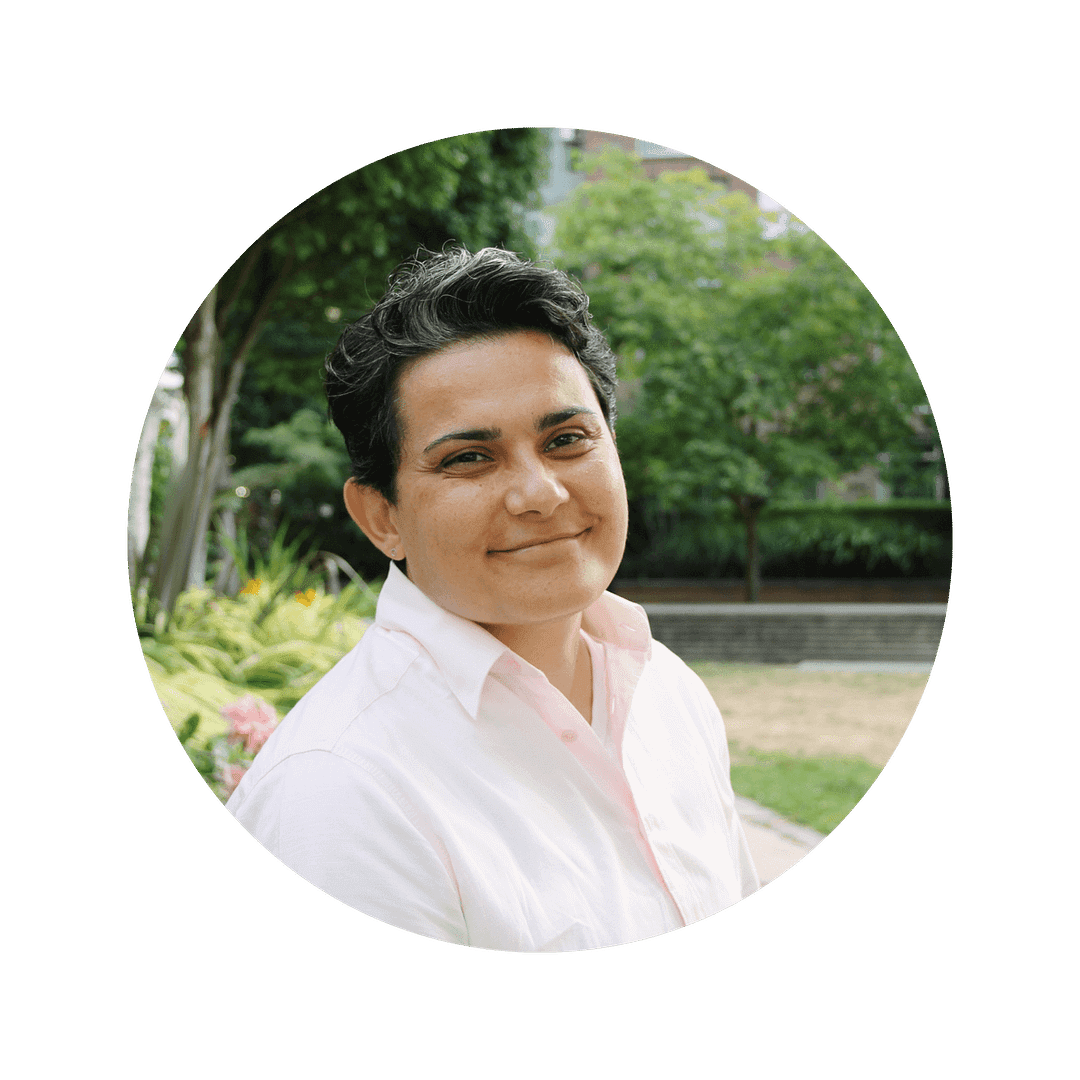
Nicki Kahnamoui, Facilitator
Nicki’s tombstone will likely read: ‘she made things happen.’ It will also say something about her strong sense of integrity and contagious enthusiasm.With over two decades of experience in strategic and operational planning and implementation, Nicki partners with established and emerging mission-driven organizations to identify and create pathways to organizational clarity, development, and sustainable impact. Nicki approaches her work from a social justice lens, meeting organizations where they are at and supporting them in their transformation efforts in line with their mandates.Nicki is a first-generation immigrant from Iran and settler on the traditional territories of the sḵwx̱wú7mesh (Squamish), sel̓íl̓witulh (Tsleil-Waututh), and xwməθkwəy̓əm (Musqueam) nations.

Bridget MacIntosh, Digital Engagement Coordinator
Bridget has held senior cultural policy and programming management positions with the cities of Toronto, Mississauga and Hamilton with portfolios spanning arts, events, public art and cultural planning. Notable accomplishments include the creation of the City of Hamilton’s Events Office where she led the design and delivery of numerous city-wide celebrations and extensive community engagement to develop a support system to facilitate 400+ annual creative placemaking, community and tourism events.
As a passionate arts advocate, Bridget’s has contributed to numerous committees and boards with organizations such as the Canadian Arts Coalition; Project for Public Spaces Placemaking Leadership Council, Festivals and Events Ontario, Toronto Alliance for the Performing Arts and foldA (Festival of Live Digital Arts).
Leadership Emergency Arts Network (LEAN Canada)
In addition to sharing the reports and outcomes from the Future of Arts Work project, Mass Culture is pleased to share the report and results from the Leadership Emergency Arts Network (LEAN) initiative. LEAN was an immediate, grassroots, pro bono response network to help Canadian professional non-profit arts organizations (big and small) deal with the COVID-19 crisis. Celia Smith, Jeanne LeSage and Michèle Maheux launched this national initiative on March 31st 2020 and sunset the initiative after a six month run in October 2020. Provided here are the final report and summary presentation which represents a compilation of the LEAN initiative’s process, statistics and feedback from participants. These reports provide a snapshot in time of the challenges and struggles facing arts organizations in the first six months of the pandemic in the midst of the unprecedented shut down of our sector.
This initiative is in partnership with
This initiative is funded by
